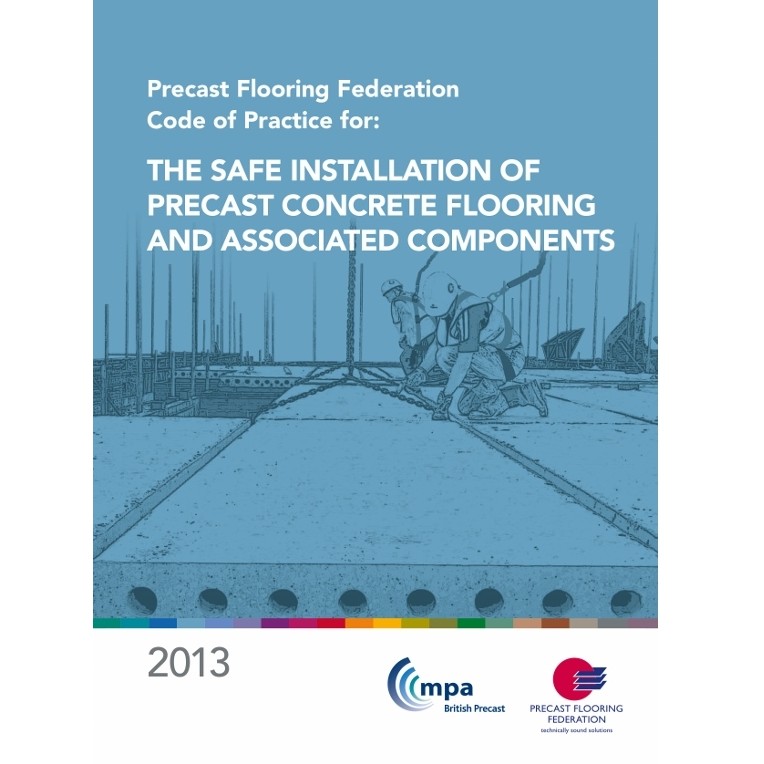
The official launch of the latest revision to the highly respected Precast Flooring Federation’s Code of practice for the safe erection of precast concrete flooring and associated components will be launched on Thursday.
Members of PFF believe this code is of such importance that they have voted that adherence and independent audit to the code is a mandatory condition of membership of their federation. Precast concrete floors offer excellent in use performance with respect to durability, acoustics, fire and thermal mass, and now installation by PFF members will be even safer.
Last revised in 2007, the Code has been expanded to embrace aspects not previously covered. For example, the manual handling operations regulations have been extended to incorporate noise and vibration at work. Another introduction is a reference to the regulations for silica dust in HSE guidance publications CIS 36 Silica dust and CIS 54 Dust control on concrete cutting saws.
As regards design, there are now specific provisions for installing precast concrete flooring onto steelwork. In addition, the installation of precast concrete floors on masonry now includes guidelines for thin joint construction.
Section 10 has been considerably modified as regards lifting equipment. There are now requirements for planning the lifting operation, with the selection and duties of personnel clearly defined. Section 10.7 gives guidelines for selecting cranes, the specific documentation required being set out in Section 10.8.5.3. Crane siting is also covered and there is a new requirement for the main contractor to confirm the hardstanding bearing capacity and for a ‘Permit to lift’ confirmation.
Operating machinery near overhead cables is always a danger and the Code now considers such proximity hazards in Section 10.12, with particular reference to working near electricity lines and aerodromes/airfields. Of course, crane designs vary enormously and so guidelines for different types of crane have been added. The new Code also covers the new Notification of Conventional Tower Cranes Regulations 2010 (Section 10.13.3).
In addition, there are notes on other lifting devices and additional guidelines on barring and jacking when moving components and materials. Finally, as regards additional on-site works, the use of in-situ concrete section now includes more detail along with provisions for cutting units on site.