Carillion’s collapse
is generating risks and opportunities that will ripple across the construction
industry over the coming weeks and months, according to Glenigan.
The failure of a
firm of Carillion’s size has significant implications, not only for its clients
and employees, but also its supply chain and competitors.
Glenigan is keeping
under review all 188 active construction projects with which Carillion is
involved, including frameworks and joint ventures. We will provide subscribers
with updated contact details and status reports on individual projects as they
become available, including the re-tendering of contracts.
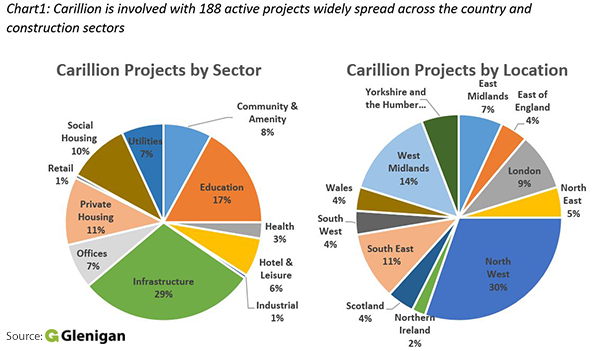
Infrastructure and
public sector projects account for the majority of Carillion’s project
workload, although the firm is involved in a wide range of projects spread
across the UK.
Encouragingly the
Government has announced that it will provide “the necessary support to ensure
that continuity of public sector services provided by the firm”. The Official
Receiver, PwC, has also stated that its priority is to ensure the continuity of
public services while securing the best outcome for creditors. PwC are asking
all employees, agents and subcontractors to continue to work as normal, unless
told otherwise, and have announced that they will be paid for the work they do
during the liquidations.
Carillion’s collapse
holds clear risks, not only for suppliers’ cash flow and balance sheets, but
potentially for the wider industry’s supply chain. Whilst the official receiver
has reassured subcontractors that they will be paid for future work on Carillion
projects, subbies and suppliers will join the list of creditors for any
payments on outstanding work. Main contractors will wish to assess the exposure
of their own supply chain and to work with them to minimise any risks.
Carillion were
partners on a number of joint ventures, including the Aberdeen Western
Peripheral Route and HS2. The other contractors on these projects will be
expected to take on the firm’s obligations. Whilst this will potentially boost
their earnings, it will also be an additional and unscheduled call on their
resources. Among other things the increased workload may dampen the firms’
appetite to bid for new projects in the near term.
Furthermore the loss
of such a major player threatens to reduce overall industry capacity,
particularly for the delivery of major projects. This has implications for
clients, especially for the Government as it looks to increase infrastructure
investment as part of its Brexit strategy. Clients may choose to re-organise
major projects in the future in order to increase the opportunity of a wider
range of contractors, including medium sized firms to undertake such work.