Intro
It is estimated we spend 90% of our time inside buildings. Studies show that for our internal comfort and general well-being, we need to reduce glare and excessive solar gains but also retain natural daylight and a visual contact with the external environment.
Providing a comfortable lux level is a legal requirement for employers. Blinds and shutters have the ability to provide us with the desired levels of light.
“Windows shall be fitted with a suitable system of adjustable covering to attenuate the daylight that falls on the workstation.”
The Health & Safety (Display Screen Equipment Regulations) 1992
What is glare?
Glare occurs when one part of the visual field is much brighter than the average brightness of the surrounding area. Where there is direct interference with vision, the condition is known as disability glare.
Where vision is not directly impaired but there is discomfort, annoyance, irritability or distraction, the condition is called discomfort glare. It is especially important to limit any glare at the workplace in order to avoid errors, fatigue and also accidents (EN 12464-1:2002).
Installation of blinds is one of the most effective methods of reducing glare. In general glare is reduced by a low openness coefficient. As the openness value increases, so do the daylight levels, the through vision and the possibility of glare. As such the key performance consideration is Tvis, that is the amount of visible light being transmitted through the shading.
The study
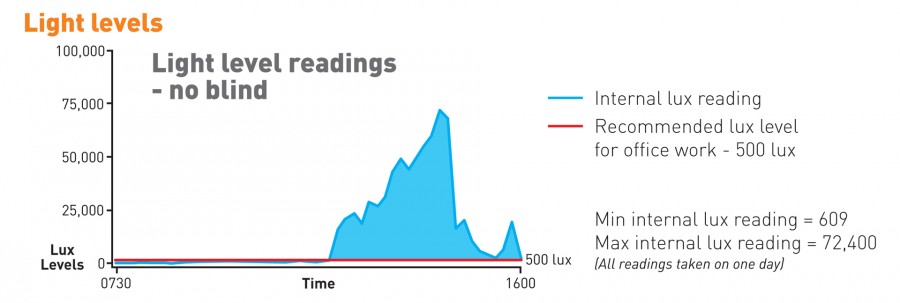
The BBSA conducted a study of newly renovated flats in north London. We measured both the temperature and the lux levels when shading wasn’t used. Lux levels in the mid-afternoon sun reached 75,000 which is 150 times more than the recommended lux level for office work.
BBSA overheating study – see the full study here.
Recommended visible transmittance values for an office environment are:
Tvis levels of 5% for a highly exposed workplace
Tvis levels of 5-10% for a moderately exposed workplace
Tvis levels 10% and higher for a north facing workplace
Watch the video here which explains how Tvis and lux levels can have an effect on building occupants.