Collaboration across all stakeholders and the standardisation of product solutions from across the supply chain are essential if productivity is to be optimised, continued investment encouraged and increasing numbers of much-needed homes constructed without undue delay.
The Government is committed to building 300,000 new homes each year by the middle of this decade, but there are already signs that achieving such a target will be a challenge.
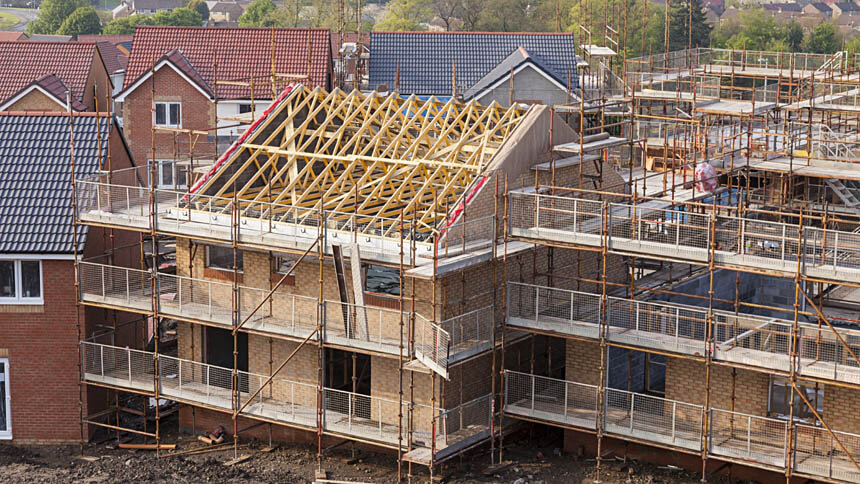
As the pressure to meet the annual housing construction target continues to intensify, the spotlight is focussing on alternative methods to improve efficiencies and productivity in the construction process and speed up completion of much-needed new homes to meet the escalating demand.
A growing area of interest is the contribution offsite construction of housing stock can make; with experts advocating that it can play a key role going forward by helping to ease the pressure on traditional building practices. If the conditions are right, many feel that offsite construction - while not a new concept - can nonetheless produce excellent results and replicate the proven success and effectiveness already seen in the automotive sector, an industry which has embraced offsite manufacturing for a number of years.
Offsite construction variations
It is important to acknowledge the differences in what is classed as an offsite construction technique. And two main approaches dominate current practice.
Traditionally, modular construction, often referred to as a ‘volumetric solution’, sees cube-shaped rooms transported to site by lorry and connected in situ to create buildings.
Sitting alongside the well-recognised volumetric approach, ‘platform frame construction’ offers an alternative approach. It is based upon the transportation of flat-packed, individual components, which are then assembled on site. Very much in keeping with the concept of flat-pack furniture.
Both methodologies are broadly utilised within the UK market.
Growing the market
If the offsite construction market is to play a meaningful role in the successful delivery of ambitious government housebuilding targets, it will need to gain traction and grow sufficiently. There is an acceptance that such success will rely on progress being made in two specific areas: early engagement and collaboration across multi-discipline project and supply teams and a standardised approach for both products and the sector’s overarching regulatory system.
Early engagement and collaboration
A key component in the success of any offsite construction-driven project is the vision and commitment of the project client. If they have the ambition to drive and support offsite manufacture from the outset, it can set the tone that pushes the project through to completion. Evidence of such commitment needs to include discussions around the offsite solution taking place in advance of any detailed design process.
Early collaboration with key specialists across the supply chain can lead to high-level coordination and successful design, providing a detailed design at a far earlier stage in the process. This leads to both supply chain trust and cost certainty which can underpin the project throughout its entirety, as well as provide future investor confidence to embark on other projects.
Early stage collaboration can also help to optimise design outcomes and ease any potential conflicts resulting from supply chain discipline crossover.
The result of early partnership would result in flexibility in product supply across all disciplines and see design consultants produce a higher level of design to ensure the project is optimised at an earlier stage, and remove the need to return to this at stage level three or four when it may be too late or costly to alter a design.
Developers wishing to utilise offsite construction to deliver housing projects can be constrained by product inflexibility. A case in point could be matching a ventilation system manufacturer with an existing modular steel frame manufacturer and how to optimise the efficiencies and productivity of putting them together from a manufacturing and assembly perspective.
In this case, the modular frame manufacturer is seeking a ventilation product supplier that is willing and able to adapt their product set to suit its manufacturing process, and this needs to be a collaborative philosophy that is replicated across all other supply chain disciplines.
Indeed, the offsite manufacturing sector says that if it is to move towards a manufacturing process where time and productivity enhancements are to be made continually and mass customisation achieved, then it requires flexible products that can offer customised and bespoke solutions.
To get to the stage where the sector is producing housing with the productivity efficiency commonly witnessed across the automotive industry – often seen as a best-in-class example – then all parties across the supply chain must come together with the shared ambition to optimise product suitability, flexibility, performance and availability.
Standardisation
Linked to the need for greater and earlier collaboration across the supply chain is the importance of driving standardisation in many areas, including product information.
This aim would see product manufacturers move to standardise and share the information around components. By being more open and prepared to knowledge share, suppliers can make a significant contribution to better outcomes for all and at the same time continue to secure new business. As such, accurate material and product details around origin, content and embodied energy needs to be more widely available and shared to better inform project leaders and satisfy client demands.
In addition, with sustainability objectives increasingly driving client demands, end-of-life status and the reusability of specified materials and products, they also need to be viewed as important factors in a productive working partnership. Doing so will help the industry to grow in volume and provide the ability to justify ongoing investment.
The sector should reflect upon the structure of the mobile phone industry which operates based on infrastructure sharing to deliver the best customer outcome. While many different phone networks service the user base, a shared distribution infrastructure enables all to benefit.
Whilst the need for closer and earlier collaboration and a more standardised approach across the sector will be the key drivers for success, other areas will also be influential when it comes to promoting growth opportunity and offsite construction’s ability to establish itself alongside traditional building methods.
Skills
Like many other industries, construction practice is coming under skills shortage pressure as demographics change, the political landscape alters, and available labour is reduced. Increasingly, a new digital-literate generation is seeking a rewarding and stimulating career and employment choices that can make the most of their understanding of areas such as data-driven Industry 4.0 and automated and advanced manufacturing technologies.
The construction sector needs to ensure that it can entice and attract such talent to capitalise on such new and in-demand skill sets and help to future proof offsite construction in the light of continued technological change. With just nine per cent of the nation’s workforce currently employed in construction, securing future talent that can add an advanced technology skillset to supplement the offsite construction offer, will be crucial in underpinning any future success.
Lead from the top
While calls for a more joined-up and collaborative approach is deemed essential to realise the true potential of offsite construction, it is also dependent on the many regulatory bodies that govern the housing and construction sectors to work together to provide direction, vision and an enabling ‘can-do’ operating environment.
A common language to distil and reduce the varying terminology currently used across the sector would be helpful, as well as efforts by various bodies to present a united front for a sector that still has too many disparate voices.
Leading the way in helping to lobby for the further alignment of current building regulations and standards would create a more even playing field, provide certainty for all stakeholders and underpin future investment ambitions.
Think Green
The housing construction sector continues to be in the spotlight when it comes to delivering a more sustainable future. For example, the Future Homes Standard has outlined the banning of gas-fired boilers in new homes among other efforts to help meet the national carbon emission reduction target set by the Government. While the shared goal of achieving significant carbon reductions and increased sustainability credentials are to be welcomed, they also necessitate new and innovative approaches to how we will construct and run our homes in the years to come.
This will be a primary focus for clients looking to invest in and develop offsite construction solutions and should also be a central consideration for product suppliers looking to secure business.
Summary
The future of offsite construction and its ability to drastically influence the course of Britain’s house-building requirements can be an optimistic one.
It will take early and sustained collaboration, partnership, intervention and sharing of knowledge to continue to gain traction as the go-to construction method. At the same time, all stakeholders must be mindful of some potential barriers to success that include building regulation constraint, current procurement practices and existing workforce skill sets.
However, offsite construction has the potential to stand shoulder to shoulder with traditional construction methods if it can focus on building greater efficiencies that are underscored by a belief in collaboration and a standardisation of approach and products across the supply chain.
Doing so opens great opportunity; one that could see the development of mass customisation for offsite construction to play a significant role in helping alleviate the nation’s house building crisis and create an effective and productive manufacturing solution that could even be exported.
Come together to build better outcomes’ is available to download at
hager.com/uk/get-involved/news-and-press/white-paper-offsite-construction-and-modular