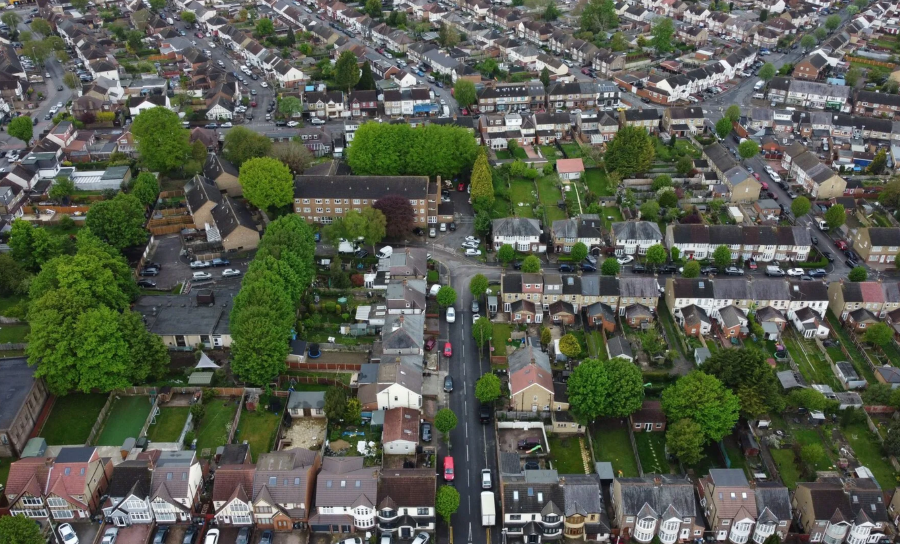
The UK construction sector should decarbonise more urgently in line with the national emission reduction targets of 68% by 2030 and 78% by 2035, according to a report published by the National Engineering Policy Centre, a partnership of 43 of the UK’s professional engineering organisations led by the Royal Academy of Engineering.
CIBSE contributed to the report as part of its work with the Royal Academy of Engineering National Energy Policy Centre. The report focuses on construction and embodied carbon but also covers operational and whole life carbon, all issues which CIBSE is active on through research, guidance and policy advice.
Decarbonising construction: building a new net zero industry calls on both government and the construction industry to set challenging but clear targets that will deliver the net zero transformation at pace and at scale.
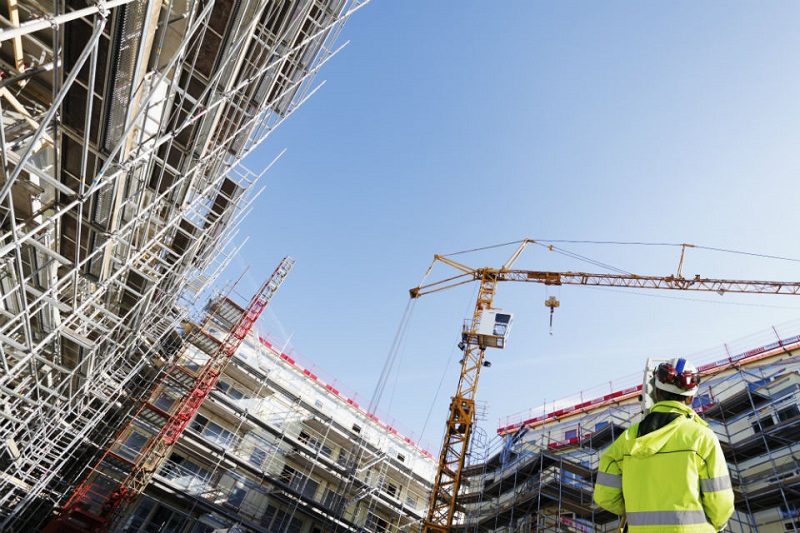
More holistic and efficient building designs, combined with measures such as reusing building materials wherever possible and using non-fossil fuel powered machinery, could help to eliminate carbon emissions from building sites, says the report. The built environment, of which the construction sector is a crucial component, currently contributes some 40% of the UK’s carbon emissions and it is estimated that the construction sector contributes up to 11% of global carbon emissions. Government, as a major client of infrastructure and building projects, can play an important role by changing its approach to procurement, to reflect whole-life carbon performance.
The UK government, as part of its 10-point plan for a green industrial revolution, has stated a clear ambition to rebuild a greener economy following the COVID-19 pandemic. According to the November 2020 National Infrastructure Strategy, the construction sector is one that requires bold transformative action. This report identifies six overarching recommendations where action taken now will result in rapid decarbonisation of the construction sector:
- The construction sector should adopt the same carbon emission reduction targets as the national targets of 68% and 78% by 2030 and 2035 respectively, compared to 1990 levels. These recommended percentage reductions should include embodied carbon of built infrastructure, including that of imported construction materials, not just the scope of emissions included in the UK carbon budget.
- Whole-life carbon assessment should be applied to public procurement: the construction sector must apply the updated guidance for appraising environmental impacts defined in HM Treasury’s Green Book, which aims to ensure that projects are assessed in terms of their contribution to the overall net zero target. The guidance in the HMT Green Book has recently been updated so that all interventions that are aimed at moving the UK towards the net zero target are first appraised in terms of their contribution to the net zero target.
- Current design and performance standards should be updated to enable more holistic design approaches for the built environment that support efficient design and reuse of materials. The updated standards must also ensure that all future projects, including those that are part of the economic stimulus following the COVID-19 pandemic, are obliged to contribute to meeting net zero. Infection control measures must also be integrated with energy efficiency to control health risks as the UK moves towards the net zero target.
- Government and the construction sector must define and promote the large-scale adoption of best practices in low-carbon procurement and construction, applying it to all new build and refurbishment projects by 2025. This must be underpinned by better use of digital technologies to improve productivity and reduce risk, such as the use of digital twins.
- Net zero and sustainability principles and practices must be a mandatory part of engineering education, continuous professional development and upskilling to change the culture of the construction industry.
- Government should apply a joined-up, systems approach across the construction sector and across government departments to ensure that total emissions from construction are minimised. Net zero emissions will not be achieved solely by building less and retrofitting existing building stock. It instead requires a radical and comprehensive transformation across the sector encompassing the definition of outcomes sought in the procurement of infrastructure, the detailed specification and design of built infrastructure and the processes of construction, retrofit and reuse. This transformation requires new systems that are consistent and joined up across these stages of the lifecycle of built assets and will need to be coherent across national, devolved and local government, placing social, economic and environmental outcomes at their heart.
Dervilla Mitchell CBE FREng, Deputy Chair of Arup Group and Chair of the National Engineering Policy Centre Net Zero working group, says: “The construction sector has already made real progress; the concrete and cement industry has delivered a 53% reduction in absolute CO2 emissions since 1990, faster than the UK economy as a whole. However, more still needs to be done if we are to get on track to meet the ultimate target of achieving net zero by 2050.
“We know how to do this. For example, the London 2012 Olympic Delivery Authority’s stated its aim to reduce greenhouse gas emissions by 50% compared with standard practice and used its purchasing power and prestige status to develop ‘sustainable concrete’, using recycled aggregate, batched on site to reduce both transport emissions and supply risk. This demonstrates the importance of mandating carbon reduction in ensuring that action is taken.
“The net zero transformation is challenging but it is also a massive opportunity for the sector. It’s a chance to make a fundamental change in our ambitions, processes and social contribution. However, we need immediate action by government, standards bodies, the construction sector and the engineering profession if we are to make it happen.”