As temperatures continue to break records, NFRC is highlighting the value roofs can offer in climate adaptation—from keeping our homes and buildings cool in summer, to minimising flooding in the wettest periods.
With high temperatures and heatwaves now expected to hit more frequently in British summers to come, our buildings need to be able to keep us cool in the hottest months, as well as insulating in winter.
Modelling of reference buildings across 15 cities across the UK in 2030, 2050 and 2080, using future climate projections, found the two greatest risks facing the UK’s built environment from climate change are overheating and flooding—as summers will become hotter and drier and winters become warmer and wetter.
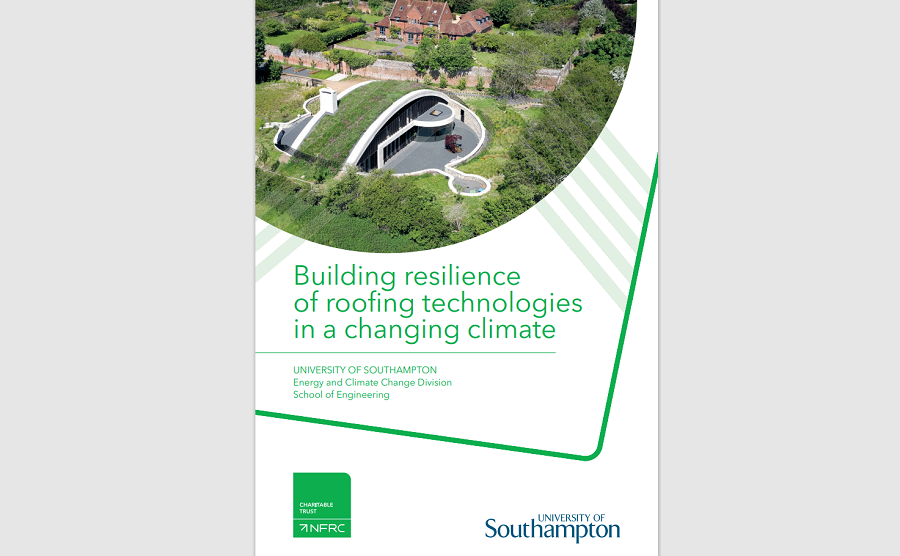
In 2021, the University of Southampton conducted research for the NFRC Charitable Trust into how roofs could contribute to much-needed climate adaptation by reducing the risks of overheating and flooding, and found that roof technologies have the potential to be a major part of the solution.
A ‘cool roof’ is one that is designed to reflect more sunlight and absorb less heat than a conventional roof, typically flat or low sloped. Highly reflective paint, sheet covering, tiles or shingles can be used to achieve this. Improved ventilation (especially night ventilation) is also a vital consideration.
These technologies also reduce the ‘Urban Heat Island effect’—in which cities and large, dense built-up areas have higher air temperatures, because the buildings and infrastructure absorb and retain heat much more than an open vegetated area would.
In the summer, standard or dark-coloured roofs can reach high temperatures (60 °C or higher), whereas a cool roof could maintain a much lower temperature (such as 40 °C) in the same conditions.
As well as reducing the Urban Heat Island effect, cool roofs can maintain comfortable conditions in buildings and reduce the need for air conditioning, lowering electricity demand.
‘Green roofs’—ballasted roofs with a waterproofing layer, soil and plants—can also reduce the Urban Heat Island effect, converting absorbed sunlight into water vapour via a natural process called evapotranspiration. This type of roof also allows a building to contribute to an area’s biodiversity, rather than harm it.
The full Future (P)roof report is available on the NFRC website, and also explores how ‘blue roofs’ can prevent or decrease the severity of floods, as well as the additional benefits of green roofs, and rooftop solar.
The report also made a number of calls to the industry and government to ensure that we are ready to benefit from these technologies. The industry should review apprenticeship frameworks and practices to ensure tomorrow’s roofers have the skills to work on green projects and new technologies like cool roofs. The UK Government and the Devolved Nations should further incentivise the retrofitting of public buildings, emphasising green technologies, to ensure they are prepared for a warmer and wetter climate.
James Talman, NFRC CEO, said: “With a heatwave expected this week, prompting the Met Office’s first extreme heat warning for parts of England, it’s vital that we consider how we are going to adapt to this particular consequence of climate change. Our built environment is going to have to change in order to keep people cool, and safe from the health effects of very high temperatures.
“There is a clear rationale behind cool roofs: a building will reflect sunlight and absorb less heat. This helps to keep the inside at a comfortable temperature, and reduces the need to use up power for air conditioning. The UK government and devolved nations should incentivise this technology as part of a necessary wider push towards commercial retrofit.”