CIBSE’s new Technical Memorandum Dynamic thermal modelling of basic blinds (TM69: 2022) recognises the role of internal shading in reducing indoor air temperatures, along the impact on internal daylight and acoustics.
Recently, the UK has experienced air temperatures in excess of 40 °C for the first time, smashing previous records. We initially adapt to excessive heat by moving into the shade. Air temperatures are always read in the shade: the sun's radiation does not directly affect the temperature reading.
The primary adaptation response is therefore to reduce the direct component of solar radiation, moving behind a tree or building, but this has little impact on the diffuse component of solar radiation coming from the clouds and sky (the direct solar beam scattered by molecules or particulates in the atmosphere) or the air temperature.
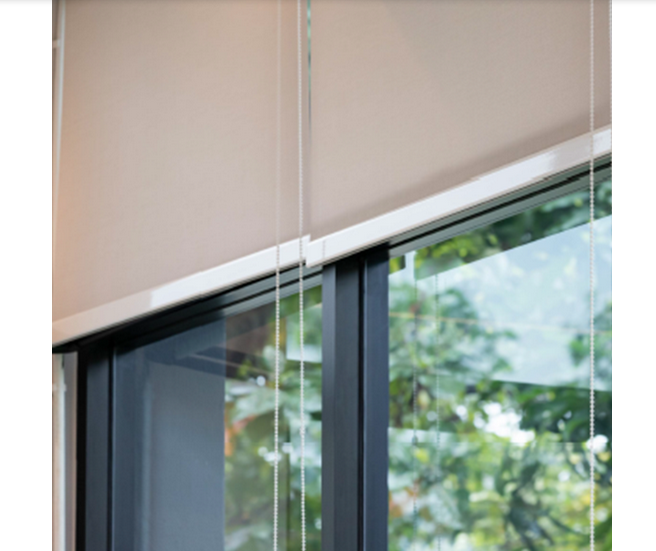
This guide highlights some of the issues associated with the discrepancies between blind performance in a model and in a real-life application. Future software applications will need to align with the relevant standards.
This guidance also recognises that shading systems, such as internal blinds, simultaneously affect internal daylight and acoustic conditions as well as the thermal and solar performance of a building.
This publication will examine some of the limitations that are present when including moveable blinds in a dynamic thermal model. The focus is on representing a more straightforward approach, in thermal analysis terms, (or ‘basic’) glass–blind systems in some typical software packages. It also suggests ‘workarounds’ for better representations. In this study, a basic blind is defined as any type of blind, but of only one layer (e.g. a flat fabric) and limited to moving only up or down, such as a roller or closed venetian blind. This publication does not examine some of the more complicated glass–blind systems such as external blinds, open interstitial blinds (i.e. between glazing layers), honeycomb blinds, or an internal venetian blind in an extended but open position (e.g. with slats positioned at a 45-degree angle).
Although Approved Document O: Overheating (HM Government, 2021) for newly developed residential buildings currently only accepts external shading as a measure to mitigate solar gains, the content of this guide will be helpful to provide a background on the combined physics of glass–blind systems, recognizing the differences between external and internal blind elements.
The development of TM69 was led by the CIBSE Building Simulation Group. It was authored by Darren Woolf (Wirth Research and Loughborough University); Maria Gabriela da Silva Costa (Useful Simple Trust); Bahareh Salehi (Mott Macdonald); and Elpida Vangeloglou (Etheras Ltd./London South Bank University).
The CIBSE Building Simulation Group Best Practice Initiative committee acknowledge the following companies and persons for their support: Ann Van Eycken (European Solar-Shading Organisation), Ben Abel (Hilson Moran), Deborah Andrews (London South Bank University), Craig Wheatley (Integrated Environmental Solutions Limited), Alessandro Baldini (Eckersley O’Callaghan), Zoe De Grussa (British Blind and Shutter Association), Shane Regan (Bentley) and Duncan MacArthur (Environmental Design Solutions Limited).
Find out more about Dynamic thermal modelling of basic blinds at https://go.cibse.org/CIBSETM69-pressrelease