The UK Green Building Council (UKGBC) has published a new toolkit to enable the construction industry to accelerate the shift from a linear to a regenerative, circular economy.
The Net Zero Whole Life Carbon Roadmap demonstrates that the UK built environment can achieve net zero carbon by 2050. For this to happen, both embodied and operational carbon must be reduced to almost zero.
Given the role circular approaches can play in lowering the embodied carbon of a building at various stages of a building’s life, the widespread adoption of circular economy principles will be essential in enabling a net zero economy to become reality.
UKGBC’s new toolkit titled ‘System Enablers for a Circular Economy’ highlights systemic barriers and the policy and market-based solutions to enable the built environment industry to shift from a linear to a circular system.
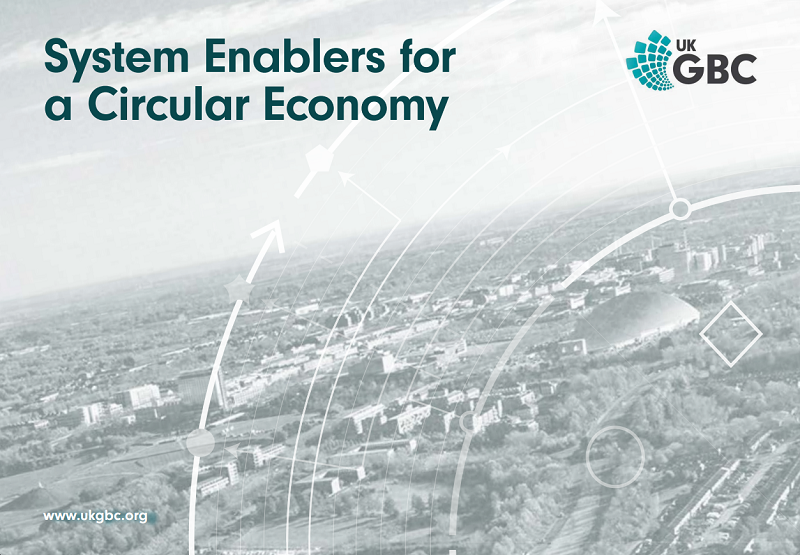
It identifies eight enablers that will encourage the shift from our current linear economic system; building a foundation upon which a circular economy across the built environment can become the default way of operating as we transition to net zero:
- Greater collaboration and early engagement between industry stakeholders
- Establishing a marketplace for secondary construction materials
- Architecture practices characterised by circular economy design principles.
- Expanding the use of green contracts and leases
- Tax, legislation, and policy systems that direct industry and markets towards circularity.
- Scaling up green finance to stimulate business support for a circular economy.
- Enabling the industry to measure progress by having a set of consistent metrics, benchmarks and indicators.
- Educating practitioners and decision-makers with the necessary knowledge to be able to implement circular economy more widely.
The toolkit highlights how the transition to a circular economy will require a fundamental change in our economy. All levels of government, industry, and civil society will need to rally behind the common goal to shift from our current extractive and wasteful linear economy towards a regenerative, circular one. It also reveals that many of the solutions needed to deliver a circular economy available exist in today’s market and can be implemented immediately. For example, the greater use of circular economy design principles ensures a deconstructable and reusable approach to architecture that keeps construction materials in use.
The key enablers identified by UKGBC illustrates the vital role for national government in securing the transition. For example, the Government can utilise its control over the UK’s tax, legislation, and policy systems to direct industry and markets towards circularity by addressing the true cost and value of materials and helping circular approaches and businesses to grow. In addition to national and local governments, the guidance also sets out a multitude of actions for the industry to adopt. From architects and contractors to the insurance and finance sectors, it provides practical guidance for how different sub-sectors can play their role.
Yetunde Abdul, Head of Climate Action at UKGBC: “Our built environment currently relies on a linear economy, where a take-make-dispose approach to construction is common practice. This approach is accelerating the climate and biodiversity crises and actively contributing to higher emissions, unsustainable levels of resource use and unnecessary levels of waste.
“Industry can either keep trying to tweak business-as-usual and make minor improvements to a failing system, or we can make fundamental, systems level changes and create a resilient, collaborative, and thriving construction sector fit for the future. UKGBC’s new guidance aims to catalyse this change through confronting some of the key barriers that exist in today’s market and signpost industry and government to the practical steps they can take to support a circular economy.”
Nicoletta Michaletos, Senior Consultant at Buro Happold: “This report outlines the very important step-change in how we need to think about sustainability and cities. Systemic thinking puts things into perspective: it focuses on a better understanding of the problem rather than providing quick fixes or solutions which, if you’re aiming at the wrong thing, might cause more harm than good in the long term. Understanding how specific industries like architecture and the built environment work almost indistinguishably within other sectors, all in line with bigger societal goals and priorities, opens our eyes to the ways in which we might need to change not only our industry tools, but reasons for building in the first place, and the lifestyles these buildings and cities support.”
Georgina Elliott, Head of ESG at Revcap: “The finance sector has a crucial role to play in supporting the transition to a circular economy, which will require mobilising long-term, patient capital and sustained green financing from across both the private and public sector. UKGBC’s report is an important piece of work with practical industry guidance which highlights the inherent, and often unidentified risks, that conventional linear ‘take, make, waste’ business models present, whilst identifying the opportunities circularity offers in helping to deliver shareholder value, support ESG objectives, align with new sustainable finance reporting regulations and mitigate physical and transition risk.
Collaborative action across the life cycle of ownership will be central to fully capitalise on this opportunity. As this report highlights, governments and regulators will need to provide the finance sector with incentives and an enabling policy framework to accelerate the integration of circularity across the built environment.”
The guidance has been designed to be relevant for a wide range of stakeholders in the built environment including national and local authorities, clients and developers, asset owners, designers, product manufacturers, builders, insurers/underwriters, demolition contractors, and recyclers.
This project forms part of UKGBC’s Advancing Net Zero Programme, which has been made possible this year thanks to the generous support of our Programme Partners: BAM Construct UK, Berkeley Group, Buro Happold, CBRE, Grosvenor Property UK, Hoare Lea, ISG, JLL, Lloyds Banking Group, ROCKWOOL, Turner & Townsend, and Project Partner Orms.