China and India are on course to realize Artificial Intelligence’s (AI) potential to be a force for good in areas including healthcare, food safety and sustainability.
While other major economies, including the United Kingdom, France and Germany, are facing a greater confidence gap linked to low levels of public trust in the technology, and risk losing out on this opportunity, a study by BSI reveals.
BSI’s Trust in AI Poll of 10,000 adults across nine countries identifies global attitudes towards AI's potential to improve our society, with more than half (52%) feeling excited about how AI can shape a better future for everyone by improving the accuracy of medical diagnosis and nearly half (49%) welcoming help from the technology in reducing food waste. 52% say AI can help create a more energy-efficient built environment.
Yet while people are aware of the opportunity for AI, there are low levels of trust globally – for example just a quarter have more confidence in AI than people to detect food contamination issues, 69% say patients need to be made aware AI tools are being used in diagnosis or treatment, and 57% feel vulnerable consumers need protections around AI. Equally, while many of us currently use AI technology (e.g., 57% use facial recognition for banking) only half of us recognize that these technologies use AI. There is a clear opportunity for education to build understanding in AI and empower people to collectively harness its capabilities.
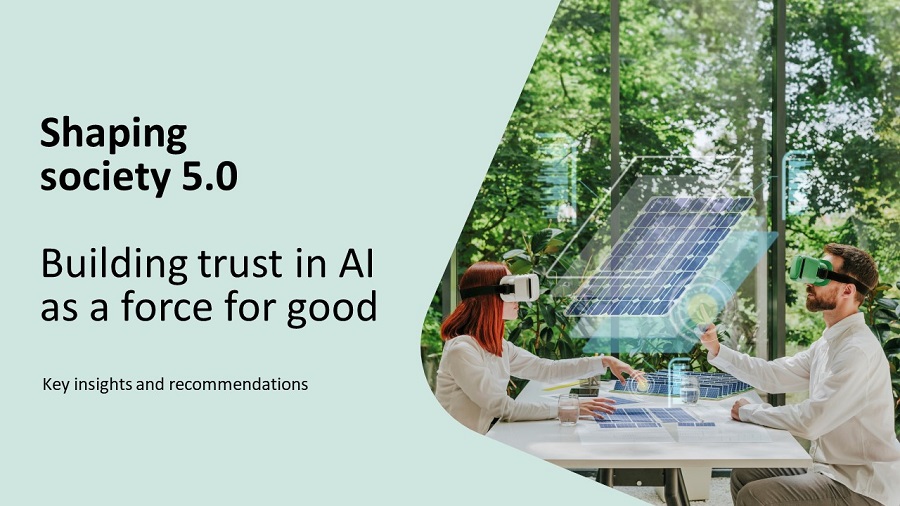
The research by the business improvement and standards company, BSI, was commissioned to launch the Shaping Society 5.0[1] essay collection, which explores how AI innovations can be an enabler that accelerates progress. It highlights the importance of building greater trust in the technology, as many expect AI to be commonplace by 2030, for example automated lighting at home (41%), automated vehicles (45%) or biometric identification for travel (40%). Over quarter (26%) expect AI to be regularly used in school within just seven years.
Three fifths globally (61%) want international guidelines to enable the safe use of AI, indicating the importance of guardrails to ensure AI’s safe and ethical use and engender trust. For example, safeguards on ethical use of patient data are important to 55% of people globally.
Engagement with AI is markedly higher in two of the fastest growing economies [2]. China (70%) and India (64%) already use AI every day at work (the global average is 38%), while 86% and 89% expect their industries to use it by 2030 (62% globally). Europe has lower levels of adoption (29% UK, 26% France, 30% Netherlands, 33% Germany) and Japan has the lowest of all (15%). By 2030, 63% of Chinese people anticipate using AI at home.
China and India also display higher current use of AI powered technology, but in fact this is surging globally, with 58% using voice-activated assistants like Alexa (88% in China) and 62% using curated playlists based on past engagement. Yet globally, people lack the awareness that these tools incorporate AI. Nearly half of smartphone users (48%) are unclear they use the technology, along with 46% for voice-activated assistants, 57% for curated playlists and 50% for chatbots).
There is clear opportunity to harness AI to drive societal progress. By 2050 three in ten (29%) say a top priority is for AI to help to reduce our impact on the environment, 28% focus on it improving medical diagnosis and a fifth (22%) pick AI helping to make society fairer and reducing inequality.
Harold Pradal, Chief Commercial Officer, BSI said: “AI is a transformational technology. For it to be a powerful force for good, trust needs to be the critical factor.”
“There is a clear opportunity to harness AI to drive societal impact, change lives and accelerate progress towards a better future and a sustainable world. Closing the AI confidence gap is the first necessary step. It has to be delivered through education, to help realize AI’s benefits and shape Society 5.0 in a positive way. BSI is proud to be at the forefront of ensuring AI’s safe and trusted integration into everyday lives around the world.”
Nearly one in five (18%) say a priority is AI making a four-day work week possible for all. Meanwhile over half globally (54%) say AI can be used most effectively to take on tasks’ humans don’t have time for, and 53% say with training they would trust AI to do parts of their job, including the most menial aspects. Notably, the way that men and women view AI in the workplace differs. Nearly a quarter of men globally (24%) would trust AI to do all parts of their job, compared to just 16% of women.
Craig Civil, Director of Data Science and AI, BSI said: “The magnitude of ways AI can shape our future means we are seeing some degree of hesitation of the unknown. This can be addressed by developing greater understanding and recognition that human involvement will always be needed if we are to make best use of this technology, and by ensuring we have frameworks that are in place to govern its use and build trust.
“Now is the moment for us to collaborate globally to balance the great power of this tool with the realities of actually using it in a credible, authentic, well-executed, and well-governed way. Closing the confidence gap and building the appropriate checks and balances can enable us to make not just good but great use of AI in every area of life and society.”
BSI has extensive expertise in the area of digital trust. (Such as Information technology — Artificial intelligence — Guidance on risk management – ISO 23984) and the forthcoming AI governance standard (ISO 42001) which draws on existing guidelines.