The Passivhaus Trust is calling on the Scottish Government to continue its plans for newbuild housing that will cut heating demand in Scottish homes by up to 79% and to hold fast against housebuilder calls to ‘pause and review’ its proposed Scottish Passivhaus equivalent policy.
The policy, which is due to be adopted as legislation in December 2024, has been developed in response to strong popular support from the Scottish Climate Assembly.
Homes for Scotland has issued its call to rethink the Scottish Passivhaus equivalent policy in response to the housing availability crisis and the recent announcement that the Scottish Government is dropping its 2030 climate targets.
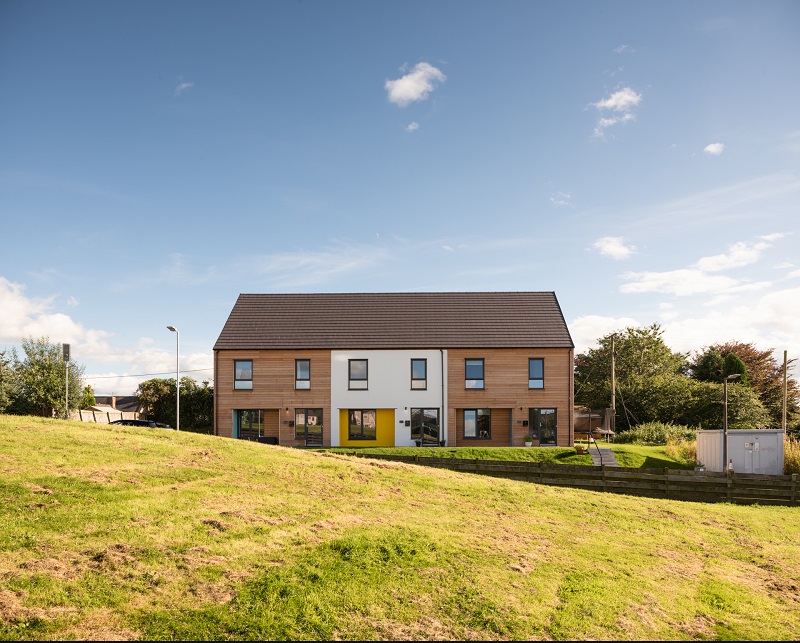
Photo: Nith Valley Closeburn Passivhaus - John Gilbert Architects
The Passivhaus Trust contends that improving energy efficiency standards will not adversely affect Scotland’s housing shortage, pointing out that higher standards were not found to be a constraint on housing supply in two recent UK Government studies. At the same time, the Trust acknowledges the difficulties currently being experienced within the Scottish construction industry which is why it is calling for a transition period for the policy implementation to allow the industry to prepare and upskill.
While the Passivhaus Trust is disappointed by the recent announcement that the Scottish Government has dropped its 2030 climate targets, it argues that this is no reason to jettison its Passivhaus policy. The Trust points out that a Passivhaus equivalent would deliver more than reduced carbon emissions, tackling the cost of living crisis, reducing spending on expanding the grid infrastructure, and saving the NHS money. The Passivhaus Trust estimates that the additional costs of building to Passivhaus are 4-8%, which can come down further with economies of scale and familiarity. Building to the Passivhaus levels of performance would reduce heating demand in homes by up to 79% compared to current Scottish building regulations.
Alex Rowley MSP, whose Member’s Bill forms the basis of the legislation, commented: “Building a Passivhaus is the epitome of a spend to save approach. By investing now, we save both financially and environmentally over the term of the project. It will benefit Scottish households by radically reducing energy bills, addressing fuel poverty, and delivering healthy mould-free homes.”
The Passivhaus Trust has also responded to Homes for Scotland's concerns regarding the "lack of a clear and co-ordinated delivery route map.”
Sarah Lewis, Research and Policy Director at the Passivhaus Trust said: “Drawing on the leading international low energy building standard, complete with design tools, skills training, qualifications, and a rapidly growing supply chain, offers the perfect clear and coordinated delivery route map. It is hard to think of another solution that has been more robustly tested. In our view, setting this as the ultimate goal, with a suitable transition period, should offer the perfect route map for housebuilders to work towards.”
Jon Bootland, CEO of the Passivhaus Trust said: “In developing the Scottish Passivhaus equivalent policy the Scottish Government has shown global leadership. We urge the Scottish Government to hold its nerve and not abandon this ground-breaking policy.
“A Scottish Passivhaus equivalent would deliver so many benefits to the people of Scotland in terms of radically reduced energy bills, improved health outcomes, and improved grid capacity through reduced peak demand.
We understand that it is challenging for housebuilders to change their practices but would argue that Passivhaus is not the big leap they might be imagining. We have seen the Scottish construction sector rise to the challenge of building to Passivhaus in the schools sector – with 35 Passivhaus schools currently underway in Scotland. We would urge Homes for Scotland members to work with us to develop solutions.
“We have identified key recommendations for how the policy could be implemented in Scotland and have emphasised the need for a transition period to allow the industry to upskill and prepare.”