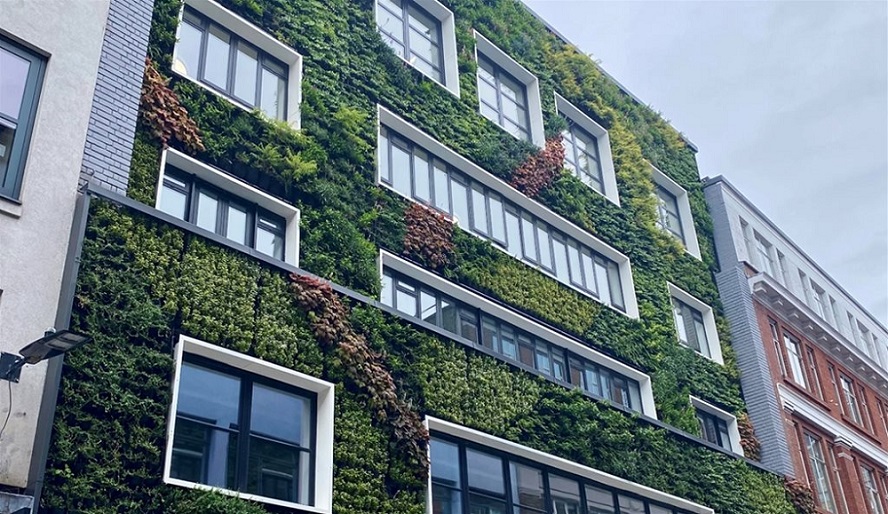
A new joint guide has been published that considers the potential risks associated with green and living walls as external cladding if incorrectly designed or managed.
With green and living walls becoming a familiar feature of the built environment, the document, entitled Green and Living Walls as External Cladding – A Joint Guide to Managing Risk, seeks to consider the “implications that the provision of living walls may have for the resilience of the building, and the continuity of business or provision of services that are provided from it”.
In particular, it addresses those risks relating to fire, escape of water (EoW), and weather events. As the document states: “Many Living Walls are of a scale and location that presents no additional risk to the scenario that would warrant further consideration, but others, applied at larger scale to a building, might have the potential to exert great influence on the safety and insurability of that building – and others around it – if not properly designed and maintained.”
Produced collaboratively between key living wall providers and UK insurers through the FPA’s RISCAuthority research scheme, the guide has already been endorsed and supported by several organisations, including Vertical Meadow, Viritopia, ABI, Biotecture, Growing Revolution, and Scotscape.
Primarily aimed at building designers, façade engineers, architects, product suppliers, owners, insurers, fire services, and those directly responsible for the day-to-day upkeep, maintenance, and safety of the building, the document is split into two parts. First, an interactive questionnaire that seeks to elicit key information about the proposed living wall system and quickly gauge whether the systems need special consideration from a risk and insurance point of view. The second part covers background information and guidance for risk control, with a focus on core principles that range from engagement, testing, and documentation; materials; design; and upkeep and monitoring.
For those living wall systems where there is potential for risk, the guide suggests practical potential solutions to reduce business and property risks and assist with insurance provision, while also promoting the need for through-life monitoring and management of the system. Additionally, the document highlights that living walls are just one feature of many that insurers take into account when assessing building safety and property/business resilience.
Some of the challenges addressed within the guide stem from the following:
- combustibility of the planted biomass and its dependency on irrigation and maintenance to keep ignition and fire spread potential to a minimum
- the extensive use of plastics in some living wall designs in the potting, irrigation, and drainage systems
- the potential complexity of creating a fire-safe design when incorporated into a rainscreen-type cladding system
- a lack of guidance on the management of penetrations (windows and vents) to prevent fire ingress or egress between the building’s internal compartments, wall voids, and the living wall
- a lack of relevance of some certification tests to address the fire challenges
- the potential for the aforementioned factors to allow mass fire spread over the building, both via the planted surface, and within wall cavities behind the potting system
- an overall inadequacy in Building Regulations to address property protection
- a need to additionally consider water and wind damage potential.
Commenting on the informative guide, Professor Jim Glockling said: “The new risk management document, produced with exceptional collaboration between all stakeholders, sets out an agreed suite of core control principles, provides a framework for information exchange with the AHJ, and establishes methods of control so that the design may be tailored to meet the needs of all. With some solution parameters currently unverified, the document is as much a call for further research and testing as it is a guidance document.”
The full guidance document can be accessed here.