Greater use of homegrown C16 timber could strengthen UK manufacturing, improve supply chain resilience and support the ambitions set out in the Government’s Timber in Construction Roadmap, according to a webinar organised as part of the Trust UK C16 Timber Campaign.
The webinar, which was hosted by the Institution of Structural Engineers, featured presentations from Louise Rogers, Impact Manager at BE-ST (Built Environment Smart Transformation), Rob MacKenna, General Manager for South Scotland at James Jones & Sons, and Mark Kirk, Chartered Structural Engineer and Technical Director at Paramount Structures.
The campaign itself is a collaboration between the UK’s three largest sawmilling businesses, James Jones & Sons, BSW Timber and Glennon Brothers, supported by industry partners including Timber Development UK and Confor. Its aim is simple: encourage specifiers, engineers, merchants and contractors to use C16 timber wherever it is technically appropriate, helping unlock greater demand for UK-grown timber.
Opening the session, Rogers highlighted the significant opportunity that exists to increase timber use across the UK, particularly in England, where brick and block construction remains dominant. She pointed to the publication of the Government’s Timber in Construction Roadmap as evidence of growing political support for timber construction and domestic timber supply chains.
Rogers noted that the UK remains heavily dependent on imported timber, with around 80% of construction timber sourced from overseas. She argued that increasing the use of homegrown timber could reduce transport emissions, support rural employment and create a more resilient construction supply chain.
“We’re the second largest importer of wood globally after China,” she said. “Why would we not want to support our local economies and our local jobs?”
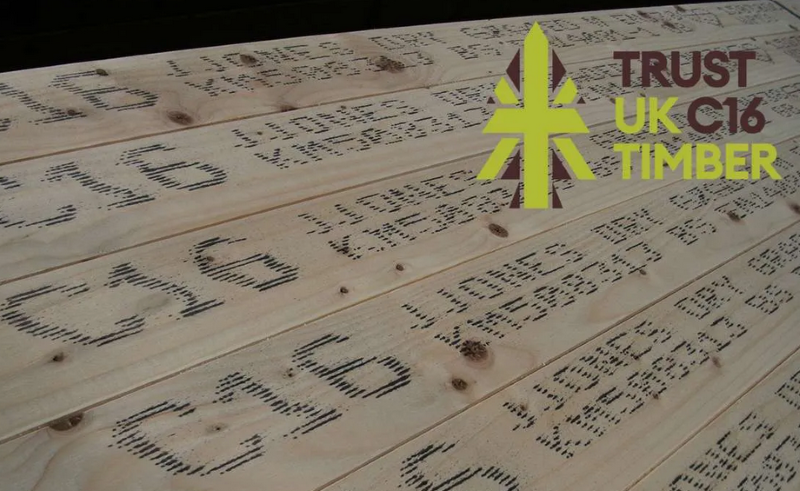
A central theme of the webinar was the relationship between C16 and C24 structural timber grades. While many designers routinely specify C24, the speakers explained that much of the UK’s homegrown spruce resource naturally grades to C16.
Rogers warned that unnecessary specification of C24 can unintentionally exclude UK-grown timber from projects. “If we’re defaulting to C24 as a strength class when C16 would be sufficient, we’re unintentionally excluding the use of homegrown timber,” she said. “A contractor could not go to the timber merchant, ask for C24 and get homegrown products.”
MacKenna expanded on this point by explaining how UK sawmills operate and why C16 is such an important product for the domestic timber industry. “C16 is a strength class assigned to graded softwood,” he explained. “It describes the characteristic properties very neatly of UK softwood.”
Although approximately 25% of UK-grown timber could achieve C24, MacKenna explained that grading timber to C16 is the most commercially viable approach because it reflects the characteristics of the majority of the resource. He stressed that C16 remains suitable for most standard residential construction applications.
The webinar also challenged some of the misconceptions that continue to surround both timber construction and homegrown timber. Concerns around strength, durability, fire performance and quality were discussed, with speakers highlighting that these issues are often rooted in perception rather than technical reality when timber is correctly designed and specified.
MacKenna highlighted the scale of investment already made by the UK timber processing sector. While the number of sawmills has reduced over recent decades, production capacity has increased significantly through automation, modern grading technologies and kiln drying facilities. “We currently have surplus capacity when it comes to drying and grading timber,” he said. “So as we stand today, capacity is not an issue when it comes to the available supply of C16.”
The Trust UK C16 campaign emerged after UK sawmillers observed a decline in market share for homegrown construction timber despite strong environmental and economic arguments for using local products.
“We started to see a dip in terms of the volume of construction timber that we’re selling into the UK market,” MacKenna explained. “How can we improve education and put information out to assist with redressing this loss of market share?”
Kirk then provided the engineering perspective, arguing that advances in design software and growing technical understanding mean C16 can now be used confidently in many applications that may previously have defaulted to C24. “Timber is becoming an increasingly more important material in construction generally,” he said. “If someone came up with a material like timber and developed that as a new material, we would be hailing it as a miracle material for the construction industry. It’s light, it’s renewable, [and] it’s resilient.”
Kirk highlighted that C16 is already widely used within the timber-frame housing sector, noting that the majority of mass-produced timber-frame homes use C16 wall studs and that many existing projects are successfully designed around the grade. He said designers can often achieve the required performance through adjustments to spacing, section size or structural arrangement rather than automatically increasing timber grade.
He also highlighted research into ‘C16 Plus’, which has demonstrated that some homegrown timber can exceed the standard requirements associated with C16 grading.
Looking ahead, the speakers identified a number of opportunities for greater use of C16 timber across UK construction. Better awareness of the product among architects and engineers, improved availability through merchant networks, increased use of timber in housebuilding and stronger alignment between forestry policy and future construction needs could all help increase demand for homegrown C16 timber products.
The webinar concluded with a clear message: using the right timber grade for the right application is not only good engineering practice, it can play a significant role in strengthening domestic supply chains and supporting the future growth of the UK timber industry.
As MacKenna summarised: “Wherever possible, specify C16. That just opens up the market for the UK supply of timber.”